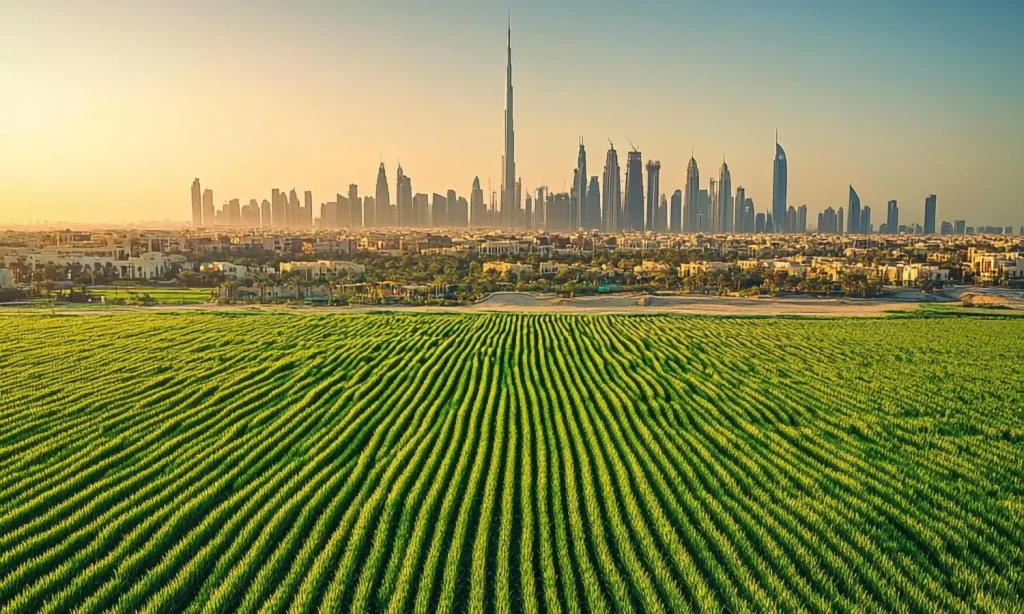
In the context of accelerating global transformations in food security, sustainability, and agri-food system resilience, the United Arab Emirates (UAE) has emerged as a distinctive case that challenges conventional assumptions regarding the constraints imposed by arid geographies. Despite its location within one of the world’s most water-scarce regions—where desert landscapes dominate more than three-quarters of national territory, rainfall levels are minimal, and temperatures are persistently high—the UAE has progressively reframed these structural constraints as catalysts for agricultural innovation and technological advancement (UAE Government Official Portal).
This strategic reorientation is institutionalised through the National Food Security Strategy 2051, which serves as the central policy framework guiding the country’s long-term agri-food transformation. The strategy articulates an ambitious objective: positioning the UAE as the leading country globally on the Global Food Security Index by 2051. To achieve this objective, the strategy prioritises the development of sustainable, technology-enabled domestic food production across the entire agri-food value chain, with a particular emphasis on the deployment of smart and advanced agricultural technologies (UAE Government Official Portal).
The National Food Security Strategy 2051 seeks to establish a comprehensive and integrated national food system grounded in principles of sustainability, efficiency, and resilience. A core element of this framework is the definition of a national food basket, comprising 18 strategically selected food commodities. The prioritisation of these commodities is informed by three interrelated criteria: (i) systematic assessment of domestic consumption patterns for key food products; (ii) national capacity for agricultural production and agro-industrial processing; and (iii) alignment with population-level nutritional requirements (UAE Government Official Portal).
Reference
UAE Government Official Portal. National Food Security Strategy 2051. Available at: UAE Government Official Portal.
- A.From an implementation perspective, the strategy encompasses 38 short- and long-term initiatives, embedded within the broader 2051 vision and supported by an operational action agenda initiated in 2021. These initiatives are structured around five strategic directions, with particular emphasis on facilitating global food trade, diversifying food import sources, and establishing alternative supply mechanisms that ensure access to between three and five sourcing options for each major food commodity. Such measures are designed to enhance supply chain resilience and reduce exposure to external shocks (UAE Government Official Portal)
The strategic objectives of the National Food Security Strategy 2051 are multi-dimensional. They include improving the UAE’s global ranking in food security indices; accelerating the integration of advanced technologies throughout domestic agricultural production; and strengthening national research and development capacities in the agri-food sector. The strategy also prioritises the development of aquaculture as a critical pillar of future protein security, alongside regulatory reforms aimed at facilitating business operations in agricultural production, simplifying agricultural contracting procedures, and enhancing access to specialised financing mechanisms for agricultural and food-related activities (UAE Government Official Portal, n.d.).
Additional objectives address broader sustainability and socio-economic considerations. These include aligning local agricultural fees with international benchmarks to enhance competitiveness, promoting the consumption of fresh locally produced food, and reducing food loss and waste through the development of integrated supply-chain interventions. Social and public health dimensions are further embedded through the establishment of food banks across the country, the strengthening of food safety and nutrition systems, and the development of targeted training programmes focused on national food safety standards and preventive measures in commercial food activities (UAE Government Official Portal, n.d.).
Collectively, these policy instruments and strategic priorities indicate that the UAE is not merely responding to food security challenges, but actively constructing a technologically advanced, resilient, and sustainable agri-food system. From an AgriFood consultancy perspective, the UAE’s experience offers a compelling policy and investment model demonstrating how innovation-driven agricultural strategies, supported by coherent governance frameworks, can reposition agriculture within environmentally constrained contexts.
Reference
- UAE Government Official Portal. National Food Security Strategy 2051. Available at: UAE Government Official Portal.